Showing posts with label green. Show all posts

Monday, August 25, 2008

Tridacna - Giant Clams

Tridacna - Giant Clams- Surigao Market PhilippinesTridacna clams belong to the family that is supposed to grab your foot if you're a careless diver, and hold you trapped until whatever, which is rubbish.

There are some truly enormous ones, Tridacna gigas, which might actually do that after a bad night out on the town, but the more usual species in the Philippines, and around the Indo-Pacific, is Tridacna squamosa, the Fluted Clam.

It's usually quite large, and full of good meat, which I don't really understand. I've never come across a Tridacna teenager, or any other juvenile, although, of course, there are small(-ish) ones, that perhaps I ignore.

The ones shown in the above photo come from Surigao City market, where they are sold in the 'cheap corner'. (That's why there's some seaweed on offer at the front).

Tridacna giant clams nakedBut de-shelled, the reasons for eating this shellfish become very, very obvious.

It's nutritious, of course, but I suspect it's visual qualities have a lot in common with full frontals published by the likes of Larry Flynt.

You wouldn't find this shell in ancient shell middens, because it's too damned heavy to carry back home.

All you need is something to cut the joint muscle between the two halves of the shell. That could be any old bit of stone or wood that you can pick up.
Then you take home the meat, and leave the shell behind.

Friday, August 22, 2008

Siargao Zingiber Project 2 - Etlingera fimbriobracteata

iuEtlingera fimbriobracteata from Siargao Island, NE Mindanao, Philippines, home of Cloud 9 surfing spotRon was the first to find one of these local ginger plants, and I wrote about them here.

I didn't realise at that time quite what a very strange plant this is.

If you look closely, you'll see a nascent bud to the left, a bud with about six yellow and red flowers open in the middle, and, to the right, what is presumably the next stage, a sort of mini-pineapple with the petals withered, and pink fruit developing.Etlingera fruit body split from Siargao Island, NE Mindanao, Philippines, home of Cloud 9 surfing spot
etlingera ginger fruit from Siargao Island, NE Mindanao, Philippines, home of Cloud 9 surfing spotNow, we haven't been watching these plants closely enough. (I've transplanted a few to my garden, where we can keep a eye on them).

Suddenly, at the next stage, they produce fruit, about 3 metres up, on long stems.

What's going on? How, exactly, does that mini-pineapple transform itself into a ten-foot fruit-bearer?

The only answer is to camp out next to one of the mini-pineapples, and photograph it, every hour, through the night.

Ron - get your sleeping-mat ready!


Update: 24/8/08. I was completely wrong on all of this. The small pineapple does NOT suddenly transform into fruit 10 feet above it, Instead, it's a different, but related plant that happened to grow in the same place, called Alpinia haenki (or macassarensis), which is even more rare.

Tuesday, August 19, 2008

Coconut Harvest

coconut harvest from Siargao Island, NE Mindanao, Philippines, home of Cloud 9 surfing spotThis is the usual three-monthly coconut harvest from the sixteen trees in my garden. The usual haul is 5 sacks, each of about 25 kilos kopras meat (about 100 pieces per sack).

It's a wonderful, bountiful tree - see: Coco Loco

climbing coconut tree in Siargao Island, NE Mindanao, Philippines, home of Cloud 9 surfing spotIt does everything you can think of, except, possibly, marriage guidance, but it's almost certainly got a secret chemical that will help with that kind of problem.

One brave fellow climbs the trees and trims off the ripe coconuts, and they come crashing down like small bombs.Lugit man shelling coconuts  Siargao Island, NE Mindanao, Philippines
Then they chop the whole nuts in half, and scoop out the meat with a specially-shaped knife, a lugit.
tapahan copra drying house from Siargao Island, NE Mindanao, Philippines, home of Cloud 9 surfing spot


The meat is now kopras, but it has to be dried first, in a tapahan, which is really a bodged-up smokehouse, like this. The smouldering coconut husks are used for fuel, and the process takes most of a day.

I've often wondered why the operators of the tapahan don't also use the process to cold smoke a few fish or sides of pork, but perhaps they've never thought of it

Friday, August 15, 2008

Siargao Zingiber Project - Sidelining

For the first time, I got up off my bum, and went myself with my crew (Ron & Shedney), to find some new and exotic ginger plants reasonably nearby.
We went to Victor's Flying Fox Bar, built, like only a total crazy could do, out in the boonies, opposite a perfect jungle mountain, where the flying foxes do a grand fly-past every evening, dead on time at 2.5 minutes past dusk.

We walked along the edge of the mountain, and we did find a couple of new ginger plants (which I'm waiting to have identified).
But, more than that, we found some other strange plants that I don't have much of a clue about:

This is wild ubi, a purple yam, that, domesticated, is a great favourite here in the Philippines. It's even a top flavour for ice cream. Purple ice cream? It's delicious. Only in the Philippines.

puso banana buds siargao island philippinesAnd we found these, abandoned: Puso banana buds, but only the stripped skins, the buds taken off to make into a fabulous salad.

And then this one, known locally as padjaw. It's an aroid, but I don't know much more about it, and I don't know why it grows 'pretend peppers'.
padjaw aroid plant Siargao Island Philippines

Siargao Zingiber Project - 1

Following on from my Pano'on 1 and Pano'on 2 posts, I've got all enthused about ginger plants.

It seems, according to John Mood, a 20-year expert on ginger (Zingiber) plant taxonomy, that we may just have a new species on our hands.

Here, it's called kayaskason, and it's very common. John asked me to preserve the leaves and inflorescence (a la herbarium, pressed between newspaper sheets). This is a bit difficult, because we don't get newspapers hereabouts, and the big fruits don't really press very well.
However, I'll do my best.

I proposed, very strongly, based on the first specimens that Ron brought to me, that the damned plant didn't have flowers.

But it does.

Here's a picture of one, a bud popped into a vase of water at 5pm and open and greedy at 7pm.

I'm not a botanist, so I really didn't know that my photo was upside down.

It looked extraordinarily like the face of one of the local horseshoe bats. Even down to the two very small 'eyes' either side of its 'nose'.

Now, if I was a bat, I'd visit this flower, and land on the strong stem just behind it. Then I'd bend over, and find I was facing the thing upside down. I would be doing 69 face to face with a friend from another biological kingdom.

Probably, I'd lap up all the ants crawling around the nectar, and then lap up some of the delectable stuff for myself.

Tuesday, August 12, 2008

Coconut Bubble

coconut with bubble as it sproutsThis is a coconut in the process of sprouting. It's sent out a small shoot through one of the three 'eyes' at the top of the coconut shell, and soon it will send out some roots through another one.

The roots will go down, while the shoot stays up, so the shell will remain on the ground but keel over, as the roots take hold.

The bubble, buwa, is the conversion of the water and flesh inside the coconut shell into an embryo of the future coconut tree. Amazing how alike this process is to mammal reproduction, where the womb holds and feeds the embryo.

This one is well on the way, so the bubble has almost filled the hard shell, while the roots haven't got going just yet. Much of the coconut flesh is still there. Give it time.

coconut with bubble as it sprouts Siargao IslandNow, if you can catch a coconut that hasn't quite reached this stage (where the bubble gets a little bit spongy) then you get this, and it's delicious.

It tastes like a sort of coconut marshmallow, juicy, fresh and sweet.

Saturday, August 9, 2008

Pool Swimmer

People keep on writing to me about why I've lived in the Philippines for all of 12 years and still like it.

Look at the photo above - 'nuff said.

Thursday, August 7, 2008

Santol Fruit

I can't do better than to quote The Daley News, an Australian tree nursery, on this fruit:

Fruit Tree of the Month
Santol - Sandoricum koetjape

Native to Asia the Santol is a large fast growing and attractive tree. In their native setting they can grow to around 45 m with a large buttressed trunk and branches low to the ground.
In cultivation they are more commonly seen as a 15 m specimen tree. In Asia the santol is valued not only for its fruits but it is also grown as a timber and shade tree, although the timber is not of high quality it does polish well.

The fruits are large, round and rough on the outside with a thick textured yellowish skin. The flesh is segmented around the 3-5 seeds, they are called lolly fruits as the flesh sticks firmly to the seeds and it is best removed and enjoyed by sucking the seeds clean. Do not be tempted to swallow the seeds.

I find these fruit (or at least the 'lolly' part) to be as insipid as so many other South East Asian fruit, a sort of jellified sweet flesh with a flavour so goddam subtle that I have difficulty describing it. And the flesh sticks to the seeds like slimy cotton wool. However,the orange skin is marvellous; very tart, and solid.

I've used it to make some very, very acceptable chutney, the kind that nearly substitutes for Branston Pickle, the essential ingredient for a genuine cheese-and-pickle sandwich.

Monday, August 4, 2008

Lato Seaweed Salad

I do love this stuff.

Koi-Koi, my neighbour, brings me some from time to time, often together with some tajum, sea urchin roe, and they go well together.

They taste like salty little grapes, bursting in the mouth in the same way as caviare, but they're aLato seaweed salad from Siargao Island, NE Mindanao, Philippines, home of Cloud 9 surfing spot lot cheaper.

This kind is my favourite. The branches are like little green Walt Disney toadstools.

To eat them, all you do is collect them straight from the sea. If you haven't got fresh sea water to rinse them in, use a little vinegar. But make sure you do wash them; a lot of tiny crabs and shrimp live in the bunches, and you don't want to chomp those as well.

I also featured another kind of lato at: Seaweeds as Food

Friday, August 1, 2008

Pako Fern - Lunchtime Salad

Pako fern from Siargao Island, NE Mindanao, Philippines, home of Cloud 9 surfing spotThis is pako fern; it grows naturally in the forests around here, and is gathered by women for sale in the local markets.

It doesn't rank very high on local food-value scales.

But it tastes wonderful, as a fresh salad, with the usual oil and vinegar dressing. It's crispy and tasty.

Here, it's thought of as an occasional delicacy, but otherwise as a famine food, the only thing you can find to eat after a typhoon or earthquake.

Last year, when exceptional rains, floods and landslides cut Lanuza (opposite my island on the 'mainland' of Mindanao) off from the outside world, this was all they had left to eat.

If the local people could somehow find a way to get this salad into Western supermarkets, they'd have a winner.
It's very cultivable.

Incidentally, when I talk about the 'usual oil and vinegar dressing', I'm not referring to all those fancy Mediterranean virgin olive oils and balsamic vinegars, that cost a fortune. I'm referring to our very own cold-pressed virgin coconut oil, and the vinegar that results from not drinking all the coconut sap tuba wine in time.

No sooner had I first written the draft of this, than I wanted to find more about this wonderful salad. Here is a photo of pako fern being served in a Vancouver restaurant, from vacationtime at Flickr. It looks as if these are the very top fiddlehead buds, braised lightly.

This is not so good; it's like the French, who braise lettuce, for god's sake. The Frogs don't know nuffink about cooking.


Here is the fern, growing wild, locally.

And, finally, here's a recipe for Kerabu pucuk pakis from a feast, everyday, who seem to come from Malaya, and are obviously interested in food, because they call themselves thedroolteam.

Pakis kerabu
2 cups pakis soft tips, washed and cut into 2" length
1 tablespoon dried prawns, washed and soaked

Dressing
1 tablespoon fish sauce
2 tablespoon lime juice
1-2 bird's eye chillies, chopped
sugar, to taste

Blanch the pakis in boiling water for 2-3 minutes; rinse in cold water and drain.
Drain the dried prawns and chop or pound coarsely; fry in a dry pan without oil over medium heat until fragrant and golden.
Sprinkle a pinch of sugar on the dried prawn to caramelise and off the heat.
Mix together the dressing, adjust to suit your taste (our palates lean heavily to the sourish side); toss in well with the pakis and chill. Mix in the dried prawns to serve.

Malay foods seem to be a lot more subtle and interesting, than Filipino foods, and that puzzles me. Perhaps the Malays have a longer and more 'civilised' culture history than my neighbours on this small island?

Thursday, July 24, 2008

Strange Fig Tree

Strange fig tree PhilippinesThis is a strange fig tree that grows in my garden. The fruit grow directly on the trunk of the tree, in bunches, quite unlike other figs, and the fruit come along every three or four months.

Sometimes birds do try and eat them, but there is not enough surface for them to perch and peck. So I left the coconut frond that fell down to give them some purchase. On a closer look, I found that the yellow figs are unripe. They go dark red as they ripen, and the birds certainly go for those.

I'm interested to see if this fig has a life style dependent on insects, as so many figs do.

Tomorrow (or maybe the next day, life being a little bit lazy) I'll get one of the figs and dissect it.

If there is a story at all, I'll post it here.
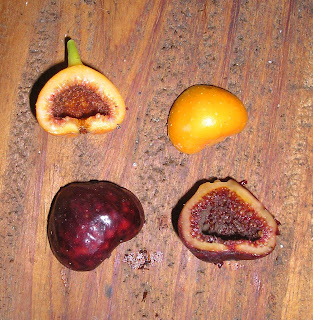
Strange Fig Philippines
[Day 2 Well, it's now tomorrow, and here is a picture of the fruit. The yellow one is unripe, and the red one was very ripe and sticky. I couldn't see any insects in either (some figs have friendly relations with tiny wasps).

Anyway, I ate it, and I'm not dead yet.

By the way, the two wires crossing the photo above are my electricity supply; great bit of junction wiring to the left.

[Day 3] I've now realised that the rest of the world gets up in the morning a lot earlier than I do, so this morning I got up and watched that bloody fig tree.

They're all there, from the sunbirds, to that-bright-yellow-bird-I-don't-the name-of, to the imported European sparrows (who chat with a Spanish, not a Cockney accent).

Wonderful sight, even through the haze of a normal morning hangover.

DH Lawrence wrote this about figs:

The proper way to eat a fig, in society,
Is to split it in four, holding it by the stump,
And open it, so that it is a glittering, rosy, moist,
honied, heavy-petalled four-petalled flower.
Then you throw away the skin
Which is just like a four-sepalled calyx,
After you have taken off the blossom with your lips.
But the vulgar way
Is just to put your mouth to the crack, and take out the flesh in one bite.
Every fruit has its secret.
The fig is a very secretive fruit
.

As you see it standing growing, you feel at once it is symbolic:
And it seems male.
But when you come to know it better, you agree with the Romans, it is female.
The Italians vulgarly say, it stands for the female part; the fig-fruit:
The fissure, the yoni,
The wonderful moist conductivity towards the centre.
Involved,
Inturned,
The flowering all inward and womb-fibrilled;
And but one orifice.
The fig, the horse-shoe, the squash-blossom.
Symbols.
There was a flower that flowered inward, womb-ward;
Now there is a fruit like a ripe womb.
It was always a secret.
That's how it should be, the female should always be secret.
There never was any standing aloft and unfolded on a bough
Like other flowers, in a revelation of petals;
Silver-pink peach, venetian green glass of medlars and sorb-apples,
Shallow wine-cups on short, bulging stems
Openly pledging heaven:
Here's to the thorn in flower! Here is to Utterance!
The brave, adventurous rosaceæ

I'm sorry, I can't go on with this. It's the plea of a Northern Englishman to a fruit he probably only tasted once in his life. It's nice stuff, but isn't he over-doing it a bit?
Rest of it at http://www.kalliope.org/digt.pl?longdid=lawrence2001061702

Friday, July 4, 2008

Nice green leaf

This is just a nice photo, one of the best I've taken recently, of the underside of a garden leaf. I can't even remember what it's a leaf of, but if you click onto the photo, you'll go to a full-size version that has an extraordinarily calming effect.

Have I just discovered a harmless version of Prozac? Probably, yes. And probably my local postman will misdeliver, again, my royalties cheque.