Showing posts with label General Luna. Show all posts

Friday, August 22, 2008

Siargao Zingiber Project 2 - Etlingera fimbriobracteata

iuEtlingera fimbriobracteata from Siargao Island, NE Mindanao, Philippines, home of Cloud 9 surfing spotRon was the first to find one of these local ginger plants, and I wrote about them here.

I didn't realise at that time quite what a very strange plant this is.

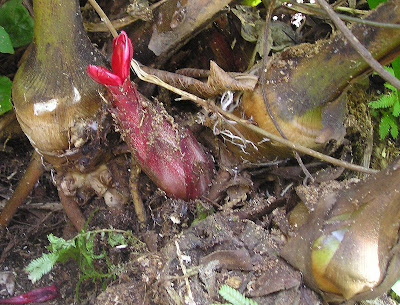
If you look closely, you'll see a nascent bud to the left, a bud with about six yellow and red flowers open in the middle, and, to the right, what is presumably the next stage, a sort of mini-pineapple with the petals withered, and pink fruit developing.Etlingera fruit body split from Siargao Island, NE Mindanao, Philippines, home of Cloud 9 surfing spot
etlingera ginger fruit from Siargao Island, NE Mindanao, Philippines, home of Cloud 9 surfing spotNow, we haven't been watching these plants closely enough. (I've transplanted a few to my garden, where we can keep a eye on them).

Suddenly, at the next stage, they produce fruit, about 3 metres up, on long stems.

What's going on? How, exactly, does that mini-pineapple transform itself into a ten-foot fruit-bearer?

The only answer is to camp out next to one of the mini-pineapples, and photograph it, every hour, through the night.

Ron - get your sleeping-mat ready!


Update: 24/8/08. I was completely wrong on all of this. The small pineapple does NOT suddenly transform into fruit 10 feet above it, Instead, it's a different, but related plant that happened to grow in the same place, called Alpinia haenki (or macassarensis), which is even more rare.

Monday, August 18, 2008

Fidelity - Female Fruit Flies Only Fuck on the First Date

fruti flies matingI'm not a lot interested in fruit flies, as such, but they (Drosophila) have been a great deal helpful to science in general and especially in the genetics corner.

It seems that female fruit flies are fussy. After the first time they have intercourse, they don't want to do it again.

Someone has discovered (or thinks he has) how.

Now this is how you find out the the details of the complicated and devious mind of the female fruit fly.

You feed them. With yeast that contains lots of heavy nitrogen. That isotope labels all of the female proteins.

Then you look at them after they've fucked. Anything that didn't have the heavy nitrogen was given by males. The researchers discovered some sixty-three proteins from fruit fly semen, which may suggest that the male fruit fly lacks confidence in his wife's fidelity, and is over-doing it a bit.

(Sorry to anyone who's offended by the fffour-letter word - the alliteration was just too good to resist).

Sunday, August 17, 2008

Curacha Dancing Crabs

Curacha dancing crabs are a speciality of Zamboanga, at the extreme right hand bottom of the Philippines.

The first time I ate them, there, I found myself sitting at the next table to Nur Misuari, the politician then in charge of the Muslim provinces (ARMM) of Mindanao, and they were delicious (no, not the politician and his cronies, but the crabs).

Since then, of course, Muslims have gone very much out of fashion.

Nur Misuari's done a bit of jail time since, but then so should anyone who sets out to be a politician; a little bit of waterboarding wouldn't go amiss.

But we also have curachas here, in Siargao, where they are known as kanduyon or ladan.

They are good to eat, because almost all the useful stuff is in the main shell, so you don't need to fuss about too much.

They're called dancing crabs, because they sit upright in the water, on their back legs, and ponce about, like a bunch of poofs at a party.

Notice their claws; they're not a lot of use, being angled in the wrong way, quite against heavy usage. they merely use them for posing.

If these things were created, then the Great Creator made more than a few design mistakes. Thank God, He won't be held accountable.

But Thank God, He made them tasty. You can find some better photos than mine here.

Friday, August 15, 2008

Siargao Zingiber Project - Sidelining

For the first time, I got up off my bum, and went myself with my crew (Ron & Shedney), to find some new and exotic ginger plants reasonably nearby.
We went to Victor's Flying Fox Bar, built, like only a total crazy could do, out in the boonies, opposite a perfect jungle mountain, where the flying foxes do a grand fly-past every evening, dead on time at 2.5 minutes past dusk.

We walked along the edge of the mountain, and we did find a couple of new ginger plants (which I'm waiting to have identified).
But, more than that, we found some other strange plants that I don't have much of a clue about:

This is wild ubi, a purple yam, that, domesticated, is a great favourite here in the Philippines. It's even a top flavour for ice cream. Purple ice cream? It's delicious. Only in the Philippines.

puso banana buds siargao island philippinesAnd we found these, abandoned: Puso banana buds, but only the stripped skins, the buds taken off to make into a fabulous salad.

And then this one, known locally as padjaw. It's an aroid, but I don't know much more about it, and I don't know why it grows 'pretend peppers'.
padjaw aroid plant Siargao Island Philippines

Siargao Zingiber Project - 1

Following on from my Pano'on 1 and Pano'on 2 posts, I've got all enthused about ginger plants.

It seems, according to John Mood, a 20-year expert on ginger (Zingiber) plant taxonomy, that we may just have a new species on our hands.

Here, it's called kayaskason, and it's very common. John asked me to preserve the leaves and inflorescence (a la herbarium, pressed between newspaper sheets). This is a bit difficult, because we don't get newspapers hereabouts, and the big fruits don't really press very well.
However, I'll do my best.

I proposed, very strongly, based on the first specimens that Ron brought to me, that the damned plant didn't have flowers.

But it does.

Here's a picture of one, a bud popped into a vase of water at 5pm and open and greedy at 7pm.

I'm not a botanist, so I really didn't know that my photo was upside down.

It looked extraordinarily like the face of one of the local horseshoe bats. Even down to the two very small 'eyes' either side of its 'nose'.

Now, if I was a bat, I'd visit this flower, and land on the strong stem just behind it. Then I'd bend over, and find I was facing the thing upside down. I would be doing 69 face to face with a friend from another biological kingdom.

Probably, I'd lap up all the ants crawling around the nectar, and then lap up some of the delectable stuff for myself.

Thursday, August 14, 2008

Morning Bakery

morning bakery of fresh bread at Bebot's Siargao Island PhilippinesEvery morning at 5am, as the sun rises, reluctantly, Bebot's wife makes bread rolls, and they're wonderful.

They're not the usual Philippines pan-de-sal, that are altogether too sweet and mushy. These are almost genuine, unsugared, bread rolls.

I buy them for breakfast (for dunking in coffee or Milo) or even, sometimes, as a special 'English' treat (sliced hot with plenty of butter and a bit of Marmite).

The oven is very high-tech. It's a galvanised iron box, with a folded corrugated-iron roof folding over. This one even has a heat shield at the front. It's fired by a pile of smouldering coconut husks on top. Bebot's wife manipulates the bread rolls with something like a bugsay (paddle), with which she whips them around like a flock of sheep.

But the main problem is that no-one in the Philippines has ever learned to make bread properly. They use soft flour; they don't mature their yeast, etc. There is nothing here remotely resembling the fresh early morning French baguette; they learned bread-making from the Spanish, who haven't a clue.

And that's a big disappointment; I would love to eat a fresh hot baguette every morning. Maybe I'll get out there one morning and start preaching. I love fresh morning-cooked bread.

Rabuls - Fighting Spider

rabuls fighting spider Siargao Island Philippines The kids here find these spiders around the place. Then they set pairs of spiders to fight along a piece of silhig (that piece of the centre of a coconut leaf, that are normally used to make brooms here).

This is a huge thing amongst the local children (who haven't got many shop-bought toys, so they have to use their imagination in ways that spoiled Western brats could never do).

They keep their champions jealously, in empty match boxes, and even trade them amongst their friends. One good spider can be worth seven pieces of candy.


Then I think back to my own youth; we used to have conkers (horse-chestnuts) that we collected in the local woods. You strung the conker and slung it against your opponent's. If that broke, you won.

Sunday, August 10, 2008

Venus in Blue Jeans

Millais Venus in technicolor I've been having a lot of idle fun in the past few days, playing with the Paint.Net program. It's fun, it's free, and (I think) it does most of what you might want.

This is John Everett Millais' 'Venus Verticordia' (Venus will turn your heart vertical). It's a winsome, bee-stung lipped nonsense, with slight symptoms of thyroid trouble in her neck.

Hans Memling Old Wona in TechnicolorHere, on the other hand, by Hans Memling, is an old lady who's seen it all.

She ain't going to take shit from nobody.


Rokeby Venus in blue jeansBut this is the best, the Rokeby Venus, by Diego Velázquez.

Truly, Venus in Blue Jeans, and one of the best bums ever painted.

Saturday, August 9, 2008

Pano'on - Local Candy - Bromeliad or What? - Part II

I first wrote about pano'on just a week ago, and things have developed rapidly. First I contacted Brandon McHenry, who identified my Dischidia or talikubo for me. He, in turn, suggested that pano'on was not a bromeliad at all, nor a relative of maize, but a relative of ginger, which was a total surprise to me.Pano'on Hornstedtia conoidea Siargao Island, Philippines

Brandon also introduced me to John Mood, a world authority on ginger taxonomy, who confirmed the plant was probably Hornstedtia conoidea, which also grows in Borneo.

Well, I hadn't seen much more of the plant than a few ripening buds and a few leaves, which had made me think it was this: Zingiber mioga - Japanese Wild Ginger, which is commercially-grown in Japan (and now in New Zealand) for its young buds, which are a great delicacy.
Zingiber mioga - Tsukuba Botanical Garden

The buds are shown here:
(Click photo to go to 'the scent of green bananas blog for recipes)

Well, this really got me thinking. If New Zealand farmers are canny enough to grow this stuff for export to Japan, why shouldn't we do the same here in Siargao? Looked easy to me; it's a perennial, so you plonk it in the ground, and pick a bit idly from time to time.

But if you look at the botanical drawing, you'll see that mioga has a white flower, whereas our pano'on's flowers turn out to have a brilliant deep red flower (top right). And the local people don't eat the buds, although they do eat the unripe berry pods (and so do rats and other forest rodents - we didn't find a single young bud on the specimens Ron brought back, from his second expedition on Thursday).

Ron also mentioned another ginger relative, locally known as kayaskason, which also has edible berries, growing at the top of a long stem, so I asked him to get some of those as well, plus anything else he could find. He came up trumps. Kayaskason turns out to be a species of Alpinia, or even a natural hybrid, and extremely rare. It seems strange that it is common enough here for the local people to give it a name.kayaskason alpinia ginger Siargao Island, Philippines

Well, that's exciting enough, but this photo shows only the unripe seed pods. We've planted it in the garden, but I don't think I can wait for the flowers to come out, so I guess we'll have to go and get some, to finally find out what it is.

'Yellow panoon Etlingeria Siargao Island PhilippinesBut the third wild ginger that Ron brought back turns out to be a little honey. You can see in this photo the yellow flowers and pink fruit. Here's another photo of the pink fruit.Yellow panoon Etlingeria Siargao Island Philippines


This one, apparently, is an Etlingera fimbriobracteata.

Now that I know these marvels are to be found in the forests around here, I'll be looking out for them.

Friday, August 8, 2008

Marang Fruit

Marang - Artocarpus odoratissimus

This fruit is about halfway between jackfruit and breadfruit, and a member of the same family. It grows on large trees (larger usually than jackfruit) and smells wonderful. That, of course is why someone called it 'odoratissimus'.

The skin is made of countless tiny tubules or spines, and you simply cut through it and twist it off, to reveal the individual fruit (actually arils, about the size of a grape). Each one of these has a large seed inside (which you can also eat, after boiling or roasting).

There's not a lot of taste to a marang, but it does smell good.

These are some I photographed in the Surigao City fruit market, going nicely yellow as they ripen.

Actually, there's a superb photograph at MVI~'s photostream at Flickr, which I can't compete with.
You'll also find more information at the ever-indispensable Wikipedia.

Shedney loves them; I am ordered, indeed commanded, to bring some whenever I do a bank run to Surigao City.

(There don't seem to be many exotic local fruit available here on Siargao Island. If people have a tree like this in their garden, it tends to go to the family, and no-one else).

Tuesday, August 5, 2008

Nukos Tinola

This delicious Filipino soup is the kind of thing that Shedney used to make for me when she was trying to impress me.

I won't bother to give an ingredients list, because it doesn't matter very much. This is a dish made at the moment from whatever you have available.

Take the usual onions, garlic, ginger, and so on, plus any spices you particularly like, give them a quick fry, and then throw in some fresh squid (nukos) , and whatever bits of vegetables you have around (this lot included mange-tout (snowpeas - a recently introduced vegetable, but nice, all the same), local cucumber, tomatoes, and some unidentifiable green leaves, probably kangkong (swamp lettuce) - the oval white things are cucumber seeds from the local cucumber; sikwa).

Don't cook it too much. You want the squid tasty and tender, not like bits of boiled rubber.

Then add water. Easy, isn't it? And delicious.


Friday, August 1, 2008

Pako Fern - Lunchtime Salad

Pako fern from Siargao Island, NE Mindanao, Philippines, home of Cloud 9 surfing spotThis is pako fern; it grows naturally in the forests around here, and is gathered by women for sale in the local markets.

It doesn't rank very high on local food-value scales.

But it tastes wonderful, as a fresh salad, with the usual oil and vinegar dressing. It's crispy and tasty.

Here, it's thought of as an occasional delicacy, but otherwise as a famine food, the only thing you can find to eat after a typhoon or earthquake.

Last year, when exceptional rains, floods and landslides cut Lanuza (opposite my island on the 'mainland' of Mindanao) off from the outside world, this was all they had left to eat.

If the local people could somehow find a way to get this salad into Western supermarkets, they'd have a winner.
It's very cultivable.

Incidentally, when I talk about the 'usual oil and vinegar dressing', I'm not referring to all those fancy Mediterranean virgin olive oils and balsamic vinegars, that cost a fortune. I'm referring to our very own cold-pressed virgin coconut oil, and the vinegar that results from not drinking all the coconut sap tuba wine in time.

No sooner had I first written the draft of this, than I wanted to find more about this wonderful salad. Here is a photo of pako fern being served in a Vancouver restaurant, from vacationtime at Flickr. It looks as if these are the very top fiddlehead buds, braised lightly.

This is not so good; it's like the French, who braise lettuce, for god's sake. The Frogs don't know nuffink about cooking.


Here is the fern, growing wild, locally.

And, finally, here's a recipe for Kerabu pucuk pakis from a feast, everyday, who seem to come from Malaya, and are obviously interested in food, because they call themselves thedroolteam.

Pakis kerabu
2 cups pakis soft tips, washed and cut into 2" length
1 tablespoon dried prawns, washed and soaked

Dressing
1 tablespoon fish sauce
2 tablespoon lime juice
1-2 bird's eye chillies, chopped
sugar, to taste

Blanch the pakis in boiling water for 2-3 minutes; rinse in cold water and drain.
Drain the dried prawns and chop or pound coarsely; fry in a dry pan without oil over medium heat until fragrant and golden.
Sprinkle a pinch of sugar on the dried prawn to caramelise and off the heat.
Mix together the dressing, adjust to suit your taste (our palates lean heavily to the sourish side); toss in well with the pakis and chill. Mix in the dried prawns to serve.

Malay foods seem to be a lot more subtle and interesting, than Filipino foods, and that puzzles me. Perhaps the Malays have a longer and more 'civilised' culture history than my neighbours on this small island?

Tuesday, July 22, 2008

Don't Go Down to the Swamps Today...

...because the Nipa Palm flower may get you.

The nipa flower's the nearest thing to a space monster that I've ever seen. They look as if they're about to come bursting and bubbling out like distinctly unfriendly extra-terrestrials. Just like Day of the Triffids. And they're big.

The flower usually grows more than a metre high, and in the fetid darkness of the brackish swamps that nipa palms inhabit, they stand out like, well, aliens.

Later, a seed head will grow, with about 40 large seeds, each enclosed in a strong husk, the whole about the size of a basketball. The seeds themselves are often called 'vegetable ivory' and are reputed to be carved by native tribesmen somewhere or other.

I tried carving them myself, but they didn't live up to their advance billing.

The nipa palm (Nypa frutescens) itself is quite innocuous, as are the flowers, of course.

The leaves are used as roofing material , widely available as roughly 4ft x 15" 'tiles', at about 8ç each. They don't last a lifetime, but they are waterproof, and a lot cooler than the corrugated iron sheets that are nowadays replacing them.

They don't need to be 'farmed' as such, but nipa stands do have owners, so be careful to ask if you want a nipa seed head as a souvenir.

The flowers, when they have grown seed heads, are tapped, like coconut flowers, for their sweet sap, which is then distilled to make pa-oroi, a strong-tasting liquor which, thankfully, is very cheap. (It's the local hooch that I mention in my blog title; I usually buy it by the 5-gallon jerry can).

I keep my hooch in a plastic water dispenser with a tap. It is half-filled with coconut-shell charcoal, that filters out the fairly awful natural taste of the pa-oroi.

My original intention was to make fruit-flavoured liquors of the stuff, by macerating some of the local fruits in it, but each time I tried that, I took to tasting it frequently, and none of my efforts ever matured, as they should have done, for more than a month.

Cheers!

PS 1 I just found I did this same story about a year ago at: http://smallislandnotes.blogspot.com/2007/10/pa-oroi.html Shows how forgetful pa-oroi makes you.

PS 2 A wonderful photo-essay on the making of pa oroi, or laksoy, as the Butuanons call it (about 3 hours drive from Surigao City is at EatingAsia:
http://eatingasia.typepad.com/eatingasia/2008/04/sago-isnt-the-o.html

Wednesday, July 16, 2008

Barringtonia - Bito'On - Sea Poison Tree

I'm getting into this digital painting lark now, and I'm thoroughly enjoying it.

This is a crudely altered photo of a Barringtonia or bito'on tree flower.

The tree grows near the shore almost everywhere in the coastal areas of Island SE Asia and Oceania.

It's a wonderful shade tree, and when it's in the mood, produces these fabulous flowers, about three inches across, with a fan of stamens (pistils?) at dusk.

The next morning, they are moribund and abandoned on the ground, as this one was.

A lovely specimen of the tree used to grow in the churchyard in General Luna, but the holy Catholic vandals of that institution cleared it of this and several other beautiful trees.

But Barringtonia doesn't only produce flowers. The fruit look a bit like squared-off apples, and they're valuable. They float very well, so they're widely used as net-floats (and also as the way for Barringtonia to colonise new shorelines).

The area of their distribution is very, very near that of Austronesian languages, and of the natural distribution of coconuts.

And the flesh of the fruit is poisonous to fish. Don't fiddle about with big, bright yellow lures, just zap 'em.

See more about Barringtonia here : (Apologies if you don't go straight to the bookmark; I haven't updated this page for ages).

Thursday, July 10, 2008

Shedney Being a Dam' Nuisance

Shedney relaxingPart of my reasoning for my extravagant investment in Shedney's new sari-sari store was to stop her sitting around like this beside my work desk, doing her devilish and seductive best to distract me.

Wednesday, July 9, 2008

Amimintiks Can See Round Light & 100,000 Colours

Update: 9 July 2008.

Original post here.

I've just learned that my tasty crustacean doesn't have quite the fastest movement of any animal (some ant can snap its jaws faster) but it is the only animal known to see Circular Polarised Light.

The story (I missed it when it came out in March) is at the Wired Science blog.

If you want to know what Circular Polarised Light is, then look at a related news story by the same writer, Brandon Keim, at Wired Science, where this photo came from.

Next time I get some, I'll look 'em right in the eyes before I cook ém.

Thursday, July 3, 2008

Raided by Communist Rebels!

Life is so humdrum that there’s nothing much to write about.

Except, suddenly last Saturday night, something newsworthy happened.

We had a raid, the first ever, from the New People’s Army, the rebels from the mainland of Mindanao, who have been fighting the government for about 40 years. They came to General Luna by boat, and shot up the police station, wounding one policeman.

They also went up the road to Katangnan, near the Cloud 9 surfing spot, and had another little fire-fight at a local self-defence-force camp , very near the main resort facilities.

Another bunch commandeered 5 vans, and went to Dapa, about 14 km away, where they did the same, and trashed the municipal offices. They also blew up the connections at two communications towers, leaving us with no cell-phones or internet for a few days.

I slept through it all, of course, and didn’t know anything had happened until Sunday morning when my cell-phone and internet didn’t work. I got the gist of it at Victor’s Sunday Lunch.

It doesn’t worry me very much; the NPA aren’t interested in foreigners, only in corrupt politicians, and everyone’s general poverty, and I am not at all unsympathetic towards their ideals.

One detail was very telling. A policeman, probably drunk, in General Luna, tried to pull out his gun when ordered to kneel down. Someone fired a warning shot, intending to miss. It grazed his leg, so they immediately gave him first aid.

When they left (it was a quick raid), two of their five boats broke down on the way home, so about 20 of them holed up on a small island that is currently being attacked by, amongst other things, helicopter gun-ships.

Sounds to me as if the Philippine authorities have absorbed all the very worst from their American mentors.

If you want to see the official story about how our intrepid police and military chased the rebels, see, the official press release.

The NPA attacked, by name, two people.

Congressman Matugas - (congressman in the Philippines is very much an inherited title - big old Spanish-, or American-helping families were given enough rewards and now have enough cash to bribe voters - much the same as in the US)
Matugas was attacked (only by pamphlet) specifically because he has a 160 hectare farm (400 acres) in the south-east of the island.

There are notices all around it warning trespassers Not to Enter. To make an estate of that size (not very big, in American terms, but a helluvalot on a small island) you have to take away traditional land used communally (and not owned) since the year dot.

But he is pro-poor. That's mostly bullshit, and before you believe it, smell it.

The NPA's other specific target was the mayor of Dapa, Boy Ruaya, who's accused of helping the drug and gambling trades in his town. The NPA are probably right.

Friday, January 4, 2008

Why Can't General Luna Make Real Money From Surfing?

Well, GL can, and it does, but not terribly well.

Newquay is a cold, nasty place, but has the only good surfing waves in England.

Read on:
Building bonanza for Cornwall's capital of surf
· Improved transport links make Newquay a hotspot · Well-to-do young invest in apartments and lifestyle

Steven Morris - The Guardian - Saturday January 5 2008
There are two sounds associated with the Cornish resort of Newquay at the moment - the crashing of surf and the clang and clatter of heavy machinery.
While developers in other parts of the UK are gloomily wondering what 2008 holds, their counterparts in the country's surf capital are enjoying boom times. The ever-increasing popularity of surfing, coupled with much-improved transport links to north Cornwall, have created a race to build new and ever more swish apartments.
Chintzy hotels are being turned into trendy apart-hotels - flats with hotel services - while tired guest houses are being converted into studio flats, or surf-pods, as the developers call them.
Two penthouse apartments have just sold for more than £1m, amid rumours that David Beckham was thinking of investing.

All this in a town which until recently had a reputation of a tatty, kiss-me-quick sort of place and is still a favourite haunt of drink-sodden stag parties.
Such is the speed of developments that no one seems sure just how many new homes are being built. But the best guess seems to be that some 1,400 properties are either under construction or going through the planning process.
Stuart Brereton, land director for the south-west with the Acorn Property Group, said young, well-to-do people were keen to invest not just in mortar and bricks but in the surf lifestyle, which generates £42m a year for Cornwall's economy.
[£42m a year - about 3.5 billion pesos - might be a bit much for Siargao to handle, but about a tenth of that might make the island a very rich place indeed - the politicians and foreign investors would take most of it, but some would filter down to the people, and they are the ones who matter]
"It's all about the sea, the surf, the buzz of surfing. A few years ago Newquay seemed a long way from London. Now there are good links to the airport and the roads are much better too."
Acorn has a cluster of developments close to Fistral beach, one of Europe's best for surfing. From its glass and aluminium sales zone overlooking the beach, it has already sold half of the 52 apartments in its Zinc complex, though they will not be ready for more than a year. Ten of the 14 properties in its Pearl development are sold, including £2m-plus penthouses.
The boom is giving established hotels a helping hand. Will Hatfield, owner of the Carnmarth, said that three years ago his customers were almost all pensioners who arrived on a coach. Now he sells his rooms mainly to professionals aged 25-45 at double the rate. "The modern-day surfer isn't a hippy in a VW van," he said. "He's a doctor, a surgeon, a solicitor, a banker. He's flying down into the airport at the weekend or flying down the A30 in his BMW."
The boom is great news for builders. "It's never been like this," said Peter Anstey, who is working on the Ocean Gate development. "There's loads of work for us." But Anstey, who was born and bred in Cornwall, also sees a downside. "Newquay is getting a makeover but the problem is very few Newquay people can afford it."

--------------------------------
...very few Newquay people can afford it.".

That's true of GL too, if local people get cut out of the profitable developments by foreigners who set up their own exclusive enclaves.

(see: Patricks On The Beach for a perfect example of a greedy foreigner who even puts up barbed wire fences to keep the people of Siargao out of his 'exclusive' resort. Follow his link http://www.mojf.org/ to see what his real scam is).

Of course, General Luna people cannot even think about buying some of the new buildings put up by foreigners. But neither can the people of Newquay. They are both restricted to their own old ways of life, but they'll manage.
If a foreigner pours a million pesos into his new luxury house, a Siargeño can build something just as good (and probably better for his lifestyle) for just P100,000. Or, not quite as good, but still very adequate, for P10,000.

Access to Newquay has turned the place around - all it had, until recently, was fishing and a few waves. Now it has good road access from London and other parts of the UK, so you no longer have to spend two days getting there.

Fishing and a few waves is all that General Luna has.

But access to Siargao and GL is extremely difficult

Minimum time from Cebu, the nearest international airport is 24 hours, including one overnight boat trip, a six-hour wait in Surigao City, and a 3-4 hour trip to Siargao. If you mis-time it, it can take a day longer. Don't forget, also, that the visitor may have already been travelling, by air, for 6-18 hours.
If the Island's politicians had any brains at all the very first thing they could do to help tourism along would be to organise the boat schedules.
Why do all the boats leave at about the same time?
(6am from Siargao, 12 noon from Surigao City to Siargao? No alternatives).
Does whoever gives them the license to run have no control at all over their schedules?
(Or is it, as most island residents think, a conspiracy to concentrate all the work of coastguards, customs, pilots, etc into as short a time as possible so they can rest for the remaining day?)

The boat services treat people like cattle. Why are they allowed to do so?

Then, when visitors arrive in General Luna, they face a horrendous road trip to Cloud 9. It's only about 4km but it can take a good hour of bumpy road travel. In the wet season, the road is almost impassable due to flooding.

This is the most important road for General Luna's prosperity, but it has been entirely neglected.

Our bright new mayor could have saved half the money he spent on fireworks to celebrate his inauguration and for 'his people' at Christmas (that was a total waste of money, because he destroyed the Boulevard where 'his people' could have sat and enjoyed the show).

Perhaps P20000 ($500) could have been spent just on dumping loads of coral rock and sand to fill the potholes between General Luna and Cloud 9

I've driven over most of the island's roads, and although some of them can be said to be bad, this stretch is definitely the worst.

The ever-increasing popularity of surfing, coupled with much-improved transport links have brought prosperity to Newquay, that cold, chilly place in England

but, here in GL, a tropical island paradise, our politicians don't seem to have given any real thought about how their town could make some real money from surfing, and no thought whatever about what they could do to help.

I like fireworks, very much, but I'd prefer to do without them and have a decent road.

Tuesday, November 13, 2007

Rain

The rainy season has begun.

A few years ago, I claimed that Siargao was the wettest place in Asia, based on a highly unscientific experiment.

Last night we had a shower, one of many over the past few days, so, this time, I set up a rigourously-controlled scientific measuring device, at about 9:45pm.
- A bucket, placed in the middle of the lawn.

This morning, the bucket was nearly full, so I measured the depth of water in it - 25cm.

Then I did various abstruse calculations to correct for the sectional conical shape of the bucket, but the difference was minimal.

That's right; about 10 inches of rain - overnight

Added - 14/12/07 - a bit later:

1 inch rain = 6.25 inches snow

This is an average value though. Colder areas will have a lower number while warmer areas will have a higher number.
http://forum.onlineconversion.com/showthread.php?t=225

But, earlier on, in the same discussion, someone wrote that his grandfather reckoned 10 inches of snow for every inch of rain.

Either way, you will get our equivalent:-
10" * 6.25" = 5 feet 2 inches of snow
or 10" * 10" = 8.3 feet of snow

Thank God it doesn't snow here. Five feet of the damned stuff would entirely cover Shedney, my 'companion'.

------------------------------
W Somerset Maugham wrote a classical story Rain
which starts out:
"It was nearly bed-time and when they awoke next morning land would be in sight. Dr. Macphail lit his pipe and...."

But even before that, Rudyard Kipling wrote: Mandalay:
By the old Moulmein Pagoda, lookin' eastward to the sea,
There's a Burma girl a-settin', and I know she thinks o' me;
For the wind is in the palm-trees, and the temple-bells they say:
"Come you back, you British soldier; come you back to Mandalay!"
Come you back to Mandalay,
Where the old Flotilla lay:
Can't you 'ear their paddles chunkin' from Rangoon to Mandalay?
On the road to Mandalay,
Where the flyin'-fishes play,
An' the dawn comes up like thunder outer China 'crost the Bay!

I really don't think, now, that Kipling ever went to Mandalay, in the very middle of the country, or to the old Moulmein Pagoda, about 400 miles away. China was near, but never 'crost the Bay. It was, and still is, due north where the dawn is unlikely to come up, let alone noisily.

But the bit that really got me (although "There's a Burma girl a-settin', and I know she thinks o' me; For the wind is in the palm-trees..." does ring certain sentimental bells) was:

I am sick o' wastin' leather on these gritty pavin'-stones,
An' the blasted Henglish drizzle wakes the fever in my bones;
Tho' I walks with fifty 'ousemaids outer Chelsea to the Strand,
An' they talks a lot o' lovin', but wot do they understand?
Beefy face an' grubby 'and --
Law! wot do they understand?

I've a neater, sweeter maiden in a cleaner, greener land!
On the road to Mandalay . . .

And that got me into this mess, where I came to avoid the world-famous English climate .

Tuesday, October 16, 2007

Cebu Ethnic Jewellery Market

If you ever decide to go hippy, and start selling ethnic jewellery to tourist punters in some exotic holiday location, as I did, for five long years, then Cebu's little 'bead street' is the place.

It's a cul-de-sac, along JC Briones St, near the port, beside the San Miguel warehouse, the Bodega San Miguel. The twenty or so stalls are lined up along the left hand side. On the right, the traders assemble to play tongit, or dama, or just to drink and chat. Right at the end is a little carinderia, run by the delicious Daisy, with good food, and sometimes an enjoyable karaoke session.

And it's incredibly good value. Some items are remainders of production lines, others are rejects, some are special productions, and others are, frankly, stolen property.

My two favourite stalls are right at the end. Whenever I'm in town, I go and meet Ernesto, and have a couple of beers and a chat. He also sells the very best cheap beads, and good lines in dream-catchers and mother-of-pearl lockets.

Thalia, next door, has an amazing selection of wooden beads (and others, of all kinds of materials), and she's a lovely lady. (I'm jealous of her boyfriend, pictured here).

Beads Cebu PhilippinesElsewhere, you can find specialist stalls dealing with shell necklaces, coral (red and blue), pearls, boars' tusks, sharks' teeth, strange minerals, and so on. Halfway down, visit Martha and Miguel; they teamed up together a couple of years ago, and do very well indeed; a Filipina-Hispano (Catalan, actually) dream team.

You might take a bit of time to understand the trade jargon; measurements sometimes in millimetres, other times in inches (typical of the Philippines, with its mixed-up Americo-Spanish culture imposition), and a whole host of descriptions of woods, bead types and sizes, etc.