Showing posts with label fruit. Show all posts

Friday, August 22, 2008

Siargao Zingiber Project 2 - Etlingera fimbriobracteata

iuEtlingera fimbriobracteata from Siargao Island, NE Mindanao, Philippines, home of Cloud 9 surfing spotRon was the first to find one of these local ginger plants, and I wrote about them here.

I didn't realise at that time quite what a very strange plant this is.

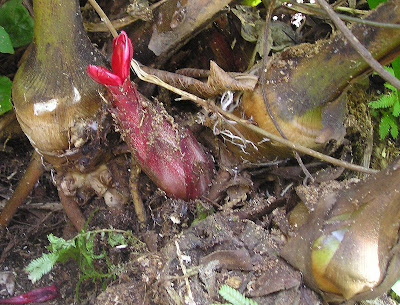
If you look closely, you'll see a nascent bud to the left, a bud with about six yellow and red flowers open in the middle, and, to the right, what is presumably the next stage, a sort of mini-pineapple with the petals withered, and pink fruit developing.Etlingera fruit body split from Siargao Island, NE Mindanao, Philippines, home of Cloud 9 surfing spot
etlingera ginger fruit from Siargao Island, NE Mindanao, Philippines, home of Cloud 9 surfing spotNow, we haven't been watching these plants closely enough. (I've transplanted a few to my garden, where we can keep a eye on them).

Suddenly, at the next stage, they produce fruit, about 3 metres up, on long stems.

What's going on? How, exactly, does that mini-pineapple transform itself into a ten-foot fruit-bearer?

The only answer is to camp out next to one of the mini-pineapples, and photograph it, every hour, through the night.

Ron - get your sleeping-mat ready!


Update: 24/8/08. I was completely wrong on all of this. The small pineapple does NOT suddenly transform into fruit 10 feet above it, Instead, it's a different, but related plant that happened to grow in the same place, called Alpinia haenki (or macassarensis), which is even more rare.

Tuesday, August 19, 2008

Coconut Harvest

coconut harvest from Siargao Island, NE Mindanao, Philippines, home of Cloud 9 surfing spotThis is the usual three-monthly coconut harvest from the sixteen trees in my garden. The usual haul is 5 sacks, each of about 25 kilos kopras meat (about 100 pieces per sack).

It's a wonderful, bountiful tree - see: Coco Loco

climbing coconut tree in Siargao Island, NE Mindanao, Philippines, home of Cloud 9 surfing spotIt does everything you can think of, except, possibly, marriage guidance, but it's almost certainly got a secret chemical that will help with that kind of problem.

One brave fellow climbs the trees and trims off the ripe coconuts, and they come crashing down like small bombs.Lugit man shelling coconuts  Siargao Island, NE Mindanao, Philippines
Then they chop the whole nuts in half, and scoop out the meat with a specially-shaped knife, a lugit.
tapahan copra drying house from Siargao Island, NE Mindanao, Philippines, home of Cloud 9 surfing spot


The meat is now kopras, but it has to be dried first, in a tapahan, which is really a bodged-up smokehouse, like this. The smouldering coconut husks are used for fuel, and the process takes most of a day.

I've often wondered why the operators of the tapahan don't also use the process to cold smoke a few fish or sides of pork, but perhaps they've never thought of it

Monday, August 18, 2008

Fidelity - Female Fruit Flies Only Fuck on the First Date

fruti flies matingI'm not a lot interested in fruit flies, as such, but they (Drosophila) have been a great deal helpful to science in general and especially in the genetics corner.

It seems that female fruit flies are fussy. After the first time they have intercourse, they don't want to do it again.

Someone has discovered (or thinks he has) how.

Now this is how you find out the the details of the complicated and devious mind of the female fruit fly.

You feed them. With yeast that contains lots of heavy nitrogen. That isotope labels all of the female proteins.

Then you look at them after they've fucked. Anything that didn't have the heavy nitrogen was given by males. The researchers discovered some sixty-three proteins from fruit fly semen, which may suggest that the male fruit fly lacks confidence in his wife's fidelity, and is over-doing it a bit.

(Sorry to anyone who's offended by the fffour-letter word - the alliteration was just too good to resist).

Friday, August 15, 2008

Siargao Zingiber Project - Sidelining

For the first time, I got up off my bum, and went myself with my crew (Ron & Shedney), to find some new and exotic ginger plants reasonably nearby.
We went to Victor's Flying Fox Bar, built, like only a total crazy could do, out in the boonies, opposite a perfect jungle mountain, where the flying foxes do a grand fly-past every evening, dead on time at 2.5 minutes past dusk.

We walked along the edge of the mountain, and we did find a couple of new ginger plants (which I'm waiting to have identified).
But, more than that, we found some other strange plants that I don't have much of a clue about:

This is wild ubi, a purple yam, that, domesticated, is a great favourite here in the Philippines. It's even a top flavour for ice cream. Purple ice cream? It's delicious. Only in the Philippines.

puso banana buds siargao island philippinesAnd we found these, abandoned: Puso banana buds, but only the stripped skins, the buds taken off to make into a fabulous salad.

And then this one, known locally as padjaw. It's an aroid, but I don't know much more about it, and I don't know why it grows 'pretend peppers'.
padjaw aroid plant Siargao Island Philippines

Tuesday, August 12, 2008

Coconut Bubble

coconut with bubble as it sproutsThis is a coconut in the process of sprouting. It's sent out a small shoot through one of the three 'eyes' at the top of the coconut shell, and soon it will send out some roots through another one.

The roots will go down, while the shoot stays up, so the shell will remain on the ground but keel over, as the roots take hold.

The bubble, buwa, is the conversion of the water and flesh inside the coconut shell into an embryo of the future coconut tree. Amazing how alike this process is to mammal reproduction, where the womb holds and feeds the embryo.

This one is well on the way, so the bubble has almost filled the hard shell, while the roots haven't got going just yet. Much of the coconut flesh is still there. Give it time.

coconut with bubble as it sprouts Siargao IslandNow, if you can catch a coconut that hasn't quite reached this stage (where the bubble gets a little bit spongy) then you get this, and it's delicious.

It tastes like a sort of coconut marshmallow, juicy, fresh and sweet.

Saturday, August 9, 2008

Pano'on - Local Candy - Bromeliad or What? - Part II

I first wrote about pano'on just a week ago, and things have developed rapidly. First I contacted Brandon McHenry, who identified my Dischidia or talikubo for me. He, in turn, suggested that pano'on was not a bromeliad at all, nor a relative of maize, but a relative of ginger, which was a total surprise to me.Pano'on Hornstedtia conoidea Siargao Island, Philippines

Brandon also introduced me to John Mood, a world authority on ginger taxonomy, who confirmed the plant was probably Hornstedtia conoidea, which also grows in Borneo.

Well, I hadn't seen much more of the plant than a few ripening buds and a few leaves, which had made me think it was this: Zingiber mioga - Japanese Wild Ginger, which is commercially-grown in Japan (and now in New Zealand) for its young buds, which are a great delicacy.
Zingiber mioga - Tsukuba Botanical Garden

The buds are shown here:
(Click photo to go to 'the scent of green bananas blog for recipes)

Well, this really got me thinking. If New Zealand farmers are canny enough to grow this stuff for export to Japan, why shouldn't we do the same here in Siargao? Looked easy to me; it's a perennial, so you plonk it in the ground, and pick a bit idly from time to time.

But if you look at the botanical drawing, you'll see that mioga has a white flower, whereas our pano'on's flowers turn out to have a brilliant deep red flower (top right). And the local people don't eat the buds, although they do eat the unripe berry pods (and so do rats and other forest rodents - we didn't find a single young bud on the specimens Ron brought back, from his second expedition on Thursday).

Ron also mentioned another ginger relative, locally known as kayaskason, which also has edible berries, growing at the top of a long stem, so I asked him to get some of those as well, plus anything else he could find. He came up trumps. Kayaskason turns out to be a species of Alpinia, or even a natural hybrid, and extremely rare. It seems strange that it is common enough here for the local people to give it a name.kayaskason alpinia ginger Siargao Island, Philippines

Well, that's exciting enough, but this photo shows only the unripe seed pods. We've planted it in the garden, but I don't think I can wait for the flowers to come out, so I guess we'll have to go and get some, to finally find out what it is.

'Yellow panoon Etlingeria Siargao Island PhilippinesBut the third wild ginger that Ron brought back turns out to be a little honey. You can see in this photo the yellow flowers and pink fruit. Here's another photo of the pink fruit.Yellow panoon Etlingeria Siargao Island Philippines


This one, apparently, is an Etlingera fimbriobracteata.

Now that I know these marvels are to be found in the forests around here, I'll be looking out for them.

Pool Swimmer

People keep on writing to me about why I've lived in the Philippines for all of 12 years and still like it.

Look at the photo above - 'nuff said.

Friday, August 8, 2008

Marang Fruit

Marang - Artocarpus odoratissimus

This fruit is about halfway between jackfruit and breadfruit, and a member of the same family. It grows on large trees (larger usually than jackfruit) and smells wonderful. That, of course is why someone called it 'odoratissimus'.

The skin is made of countless tiny tubules or spines, and you simply cut through it and twist it off, to reveal the individual fruit (actually arils, about the size of a grape). Each one of these has a large seed inside (which you can also eat, after boiling or roasting).

There's not a lot of taste to a marang, but it does smell good.

These are some I photographed in the Surigao City fruit market, going nicely yellow as they ripen.

Actually, there's a superb photograph at MVI~'s photostream at Flickr, which I can't compete with.
You'll also find more information at the ever-indispensable Wikipedia.

Shedney loves them; I am ordered, indeed commanded, to bring some whenever I do a bank run to Surigao City.

(There don't seem to be many exotic local fruit available here on Siargao Island. If people have a tree like this in their garden, it tends to go to the family, and no-one else).

Thursday, August 7, 2008

Santol Fruit

I can't do better than to quote The Daley News, an Australian tree nursery, on this fruit:

Fruit Tree of the Month
Santol - Sandoricum koetjape

Native to Asia the Santol is a large fast growing and attractive tree. In their native setting they can grow to around 45 m with a large buttressed trunk and branches low to the ground.
In cultivation they are more commonly seen as a 15 m specimen tree. In Asia the santol is valued not only for its fruits but it is also grown as a timber and shade tree, although the timber is not of high quality it does polish well.

The fruits are large, round and rough on the outside with a thick textured yellowish skin. The flesh is segmented around the 3-5 seeds, they are called lolly fruits as the flesh sticks firmly to the seeds and it is best removed and enjoyed by sucking the seeds clean. Do not be tempted to swallow the seeds.

I find these fruit (or at least the 'lolly' part) to be as insipid as so many other South East Asian fruit, a sort of jellified sweet flesh with a flavour so goddam subtle that I have difficulty describing it. And the flesh sticks to the seeds like slimy cotton wool. However,the orange skin is marvellous; very tart, and solid.

I've used it to make some very, very acceptable chutney, the kind that nearly substitutes for Branston Pickle, the essential ingredient for a genuine cheese-and-pickle sandwich.